Anyone who owns or manages land has to deal with fast-spreading, water-thirsty invasive alien plants (AIP). We started clearing our property, which borders the Klippedrift River, about nine years ago. At that stage, an Alien Clearing group existed in Napier and was doing an excellent job at the end of Reservoir Street in the Cameron McMaster Reserve. Unfortunately, some of its volunteers left Napier and the group dissolved.
During 2018/19, the Breede-Olifants Catchment Management Agency (BOCMA) launched a R9 million project to clear IAPs along the Klippedrift River from its source near the Vlêrmuisgrot (Bat Cave) on Napier Mountain downstream to its confluence with the Kars River. Unfortunately, due to the COVID-19 outbreak, the government withdrew the funds.
Consultants assessed the extent and distribution of IAP species using the list of IAPs specified in the National Environmental Management: Biodiversity Act (NEMBA). They found that over 40% of our fynbos and renosterveld areas are threatened by alien plants.
General IAP species distribution
| SPECIES | INFESTATION | CATEGORY (NEMBA) |
| Acacia saligna (Port Jackson willow) | 16.4% | 1b |
| Acacia longifolia (Golden wattle) | 2.8% | 1b |
| Leptospermum laevigatum (myrtle) | 0.8% | 1b |
| Casuarina cunninghamiana (beefwood / river oak) | 2% | 1b within 100m of riparian areas, otherwise category 2 |
| Pinus pinaster (cluster pine) | 2% | 1b with exceptions |
| Eucalyptus cladocalyx (sugar gum) | 10% | 1b within riparian areas |
| Arundo donax (cane / elephant grass) | 6% | 1b |
| Acacia cyclops (rooikrans / coastal wattle) | Significant | 1b |
| Acacia mearnsii (black wattle) | Significant | 1b |
Tackling the problem
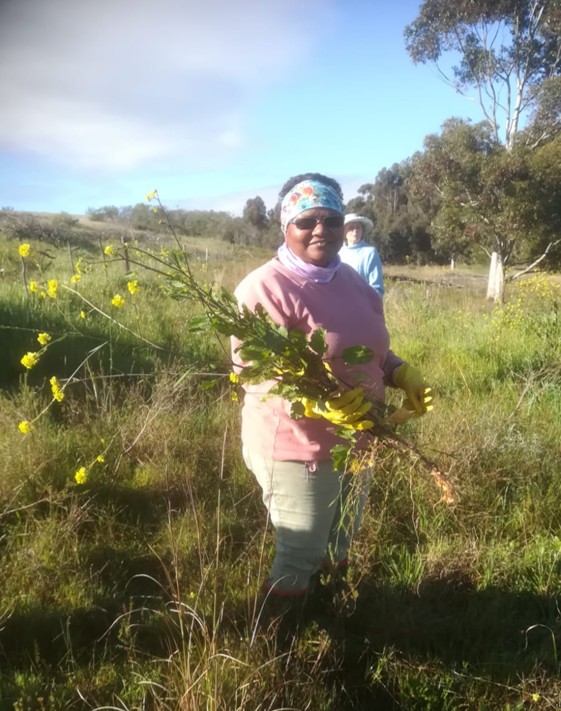
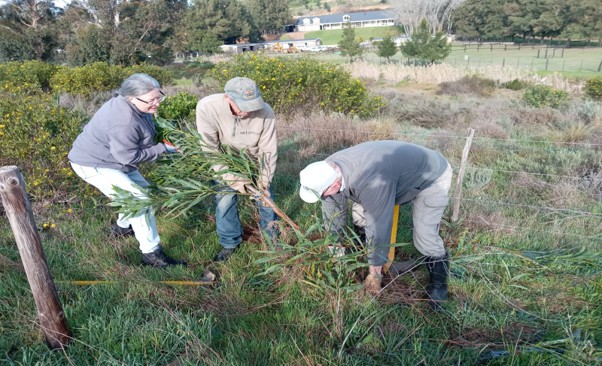
We realised the problem on our property began upstream and had to be tackled there. A group of three began clearing the Renosterveld and riparian area largely infested with Port Jackson (Acacia saligna) on municipal land along the Klippedrift River, east of Trade Street and south of Monsanto Road.
Initially, we made extremely slow progress along the riverbank because the three of us had only gardening tools and were pulling out saplings by hand. Over time, the Friday Alien Clearing Group grew to ten volunteers, working for two hours every Friday morning. We introduced bow saws to remove the larger invasive trees.
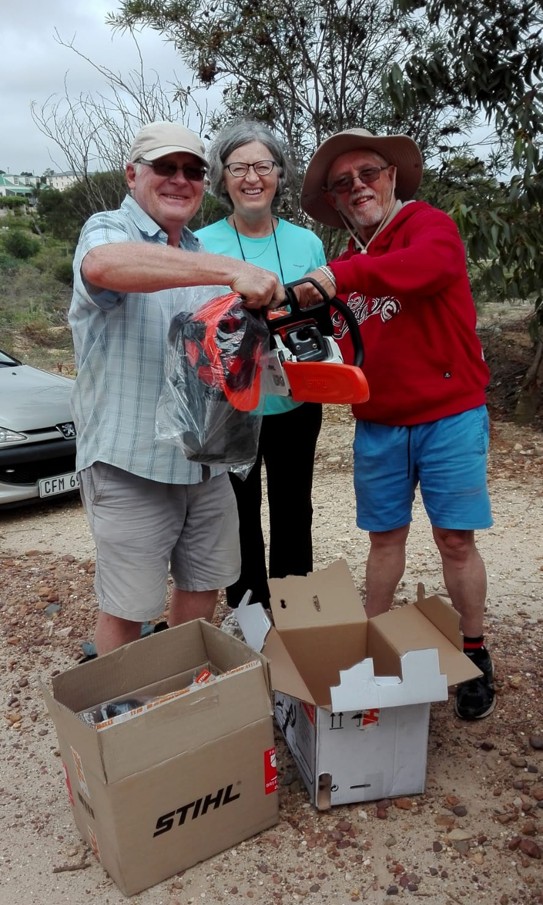
After an inspection by the Botanical Society committee under Stephen Smuts, two chainsaws were donated. The chainsaws are essential for clearing the larger Port Jacksons infesting the riparian zone eastwards towards the bridge between Napier and Bredasdorp.
Regular follow-ups
Depending on whether the invasive plants resprout (coppice), different eradication methods are required. The non-resprouting invaders, such as rooikrans and cluster pine, do not require herbicide treatment once cut down.
The invaders that coppice, such as Port Jackson, black wattle and sugar gum, must be felled just above ground level or at least below all growth nodes, and the stumps treated with an effective herbicide to kill the root system. Failing to do so will lead to them growing back with a vengeance, since the well-developed root system enables quick regrowth. Foliar spraying with an herbicide is a NO-NO, since it will indiscriminately kill even indigenous plants.
Before starting an alien plant clearing project, one must realise it is NOT a once-off action. Regular follow-ups are essential. All these plants produce enough seeds to create an enormous seed bank that will last for decades, producing invasive seedlings each year, especially after fire. For every five hectares we clear, we invest over two years doing essential follow-ups to remove new invasives before they start seeding again.
Indigenous plants return!
When we started clearing, we saw almost no indigenous plants growing among the invaders. We carried out some restoration in the riparian area by planting indigenous Carpobrotus edulus (sour fig), Osteospermum moniliferum (tick berry) and wild olive trees to stabilise the riverbanks. We stuck to these species because they are indigenous to the area.
We are always blown away by the beauty of the flowering bulbous plants that emerge after the aliens are removed. So far, we have observed more than 70 indigenous plant species emerging on the cleared land, three of which are on the Red List of plants at risk of extinction.
Join us and make a difference
We welcome all Napier residents (and their visitors) who would like to join the volunteer project to help preserve Napier’s ecological heritage. It is deeply rewarding to see the difference we make in restoring the indigenous Renosterveld and fynbos.